
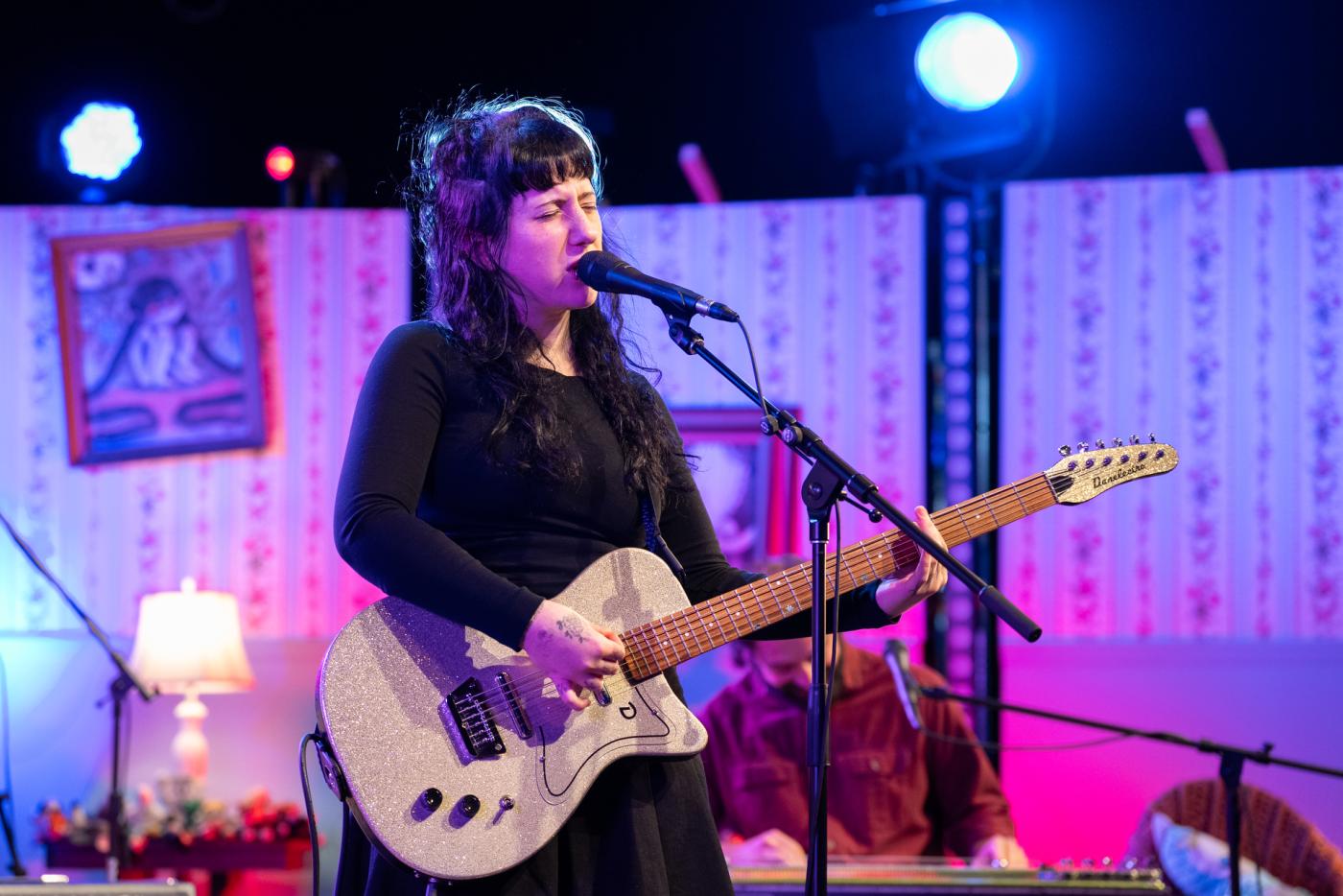
Header image: Karly Hartzman of Wednesday performs on Shaped By Sound. Photo courtesy of PBS NC.
This past May, Durham jazz trumpeter Al Strong’s episode of Shaped by Sound concluded the program’s second season. A PBS NC original series showcasing North Carolina’s thriving music scene, Shaped by Sound has been made possible through the support of the Come Hear NC Music Office (CHNCMO), a program of the North Carolina Arts Council, a division of the North Carolina Department of Natural and Cultural Resources.
And while it has become commonplace to claim that North Carolina’s an amazing place for music, Shaped by Sound proves it. The best of the state’s indie rock, rap, old-time, jazz, gospel, and country genres have shown up and shown out in these 26 half-hour episodes. The show’s interviews dig deep into the NC roots of the artists, and the live performances often find the artists outdoing their original recordings. To celebrate, we’ve selected our favorite moments of the show below. Running from artists J–Z, this is the second and concluding part of our look-back at Shaped by Sound.
And if you’d like to read our previous features on Shaped by Sound artists, from Al Strong to Wednesday, you can find them on our blog.
Jim Lauderdale, “The King of Broken Hearts”
For Shaped by Sound, Veteran country singer-songwriter dusted off “The King of Broken Hearts” from 1991’s I’m a Song. A classic slab of country, it’s all about hanging on a smile even though love has slashed and torn one’s heart.
Mipso, “My Burden with Me”
Fiddler Libby Rodenbough takes lead vocal on this dirge, a song of hardship, star-crossed love, and railroad disaster. A song that looks the facts in the face and avoids drawing toxically positive lessons from catastrophe.
Nnenna Freelon, “Here’s Your Hat”
A breakup torch song, on “Here’s Your Hat” Freelon asks her soon to be ex-love to go lightly into the night. A let-you-down-easy track, Freelon’s calm, silky delivery sells a mourning over melancholy message to her ex-flame.
Reuben Vincent, “Big Bank”
Driven by a hypnotic, funky groove, Charlotte’s Reuben Vincent blends hard rhyming with live playing seamlessly on “Big Bank.” Vincent’s dense lyrics, packed with double entendres, will keep fans of “real hip-hop” and the young heads equally pleased.
River Whyless, “Motel 6”
The Motel 6 has become a paradigmatic symbol of the lonely disorientations of “tour” (see Yo La Tengo’s “From a Motel 6,” Kinky Friedman’s “Poet of Motel 6”). In River Whyless’s “Motel 6,” the singer drops a friend off at the budget lodging before driving back east. The motel represents a sign that the old ways of the road must be left behind, even if knowledge of what’s next remains obscure.
Shirlette Ammons, “Spectacles”
A cross-genre collaboration with country singer Rissi Palmer, Ammons’ song applies Guy Debord’s notion of the society of the spectacle to racial capitalism. In plain English, white culture perpetually acts as a scavenger and mimic of black culture: “Spectacles: you’d think we were wearing dancin’ shoes / the way they clockin’ every move.”
Skylar Gudasz, “Truck”
This performance begins with a ode to listening. The singer’s driving in her mother’s truck, and running down her favorite roots artists, all women – Lucinda Williams, Emmylou Harris, Sister Rosetta Tharpe, and finally June Carter Cash (but maybe June Tabor as well?). This ode to Gudasz’s musical mothers opens up to the song’s central lyric, “I believe in everything”: an expression of the singer’s faith in the cosmic fecundity of the universe. “Truck” joyrides through a summer world pervaded by possibility, dominated by life-giving music and kind maternal figures.
Sluice, “Mill”
A trip to a swimming hole that ends up less bucolic than expected: the paramedics have to be called in. Where does one focus one’s attention here? Because the buzzing chainsaws, the trash on the trail, snatches of dialogue from the singer’s relationship, and everything else here seems to rest on the same plane within the aimless drift of untethered life.
Sonny Miles, “Slow”
A slow-jam that turns orchestral, Sonny Miles stays in the pocket throughout “Slow,” a model of pure focus. “Slow” asks listeners to pump the brakes and get in touch with the spirit of love.
Superchunk, “Hyper Enough”
When it came out in 1995, Superchunk’s “Hyper Enough” cut a particular path in the indie/punk wilds: heavy and fast but not aggressive, edgy but not explicitly political, emotive but not emo. Literate slackers everywhere could relate to this ode to coffee, emotional overwhelm and bruised feelings. On Shaped by Sound, the rhythm section’s (Betsy Wright and Laura King) is completely different from the album version (Laura Balance and Jon Wurster), resulting in a version of “Hyper Enough” where the bassline sounds separated and the drums cut through.
Tan & Sober Gentlemen, “Rock, Salt & Nails”
The folk standard “Rock Salt & Nails” is usually played slowly to suit its mournful tone. We broke down the history of the song in our deep dive for Tan & Sober Gentlemen’s episode. Tan & Sober Gentlemen kick up the tempo and flesh out the arrangement, bringing the simmering hurt latent in Utah Phillips’ lyric to the fore.
Town Mountain, “Lines in the Levee”
“Lines in the Levee” finds Town Mountain in populist anthem mode, with lightly encrypted lyrics about exploitation, impending disaster, and the need for folks to “wake up.” A song for a divided America, a la the great folk disaster songs of old. The singing’s ragged but right.
Wednesday, “Reality TV Argument Bleeds”
Nobody’s doing it like Greensboro’s Wednesday, mixing country rock and shoegaze, slacker cool with New South slices of life. Karly Hartzman and Company’s performance of “Reality TV Argument Bleeds” on Shaped by Sound puts the band’s singular sound up front, starting with a scream and Xandy Chelmis’s lap steel band splitting the difference between My Bloody Valentine and Sneaky Pete. A tale of teenage anomie, “Reality TV Argument Bleeds” is a tone poem to the uncanny sights and sounds of everyday family dysfunction.