
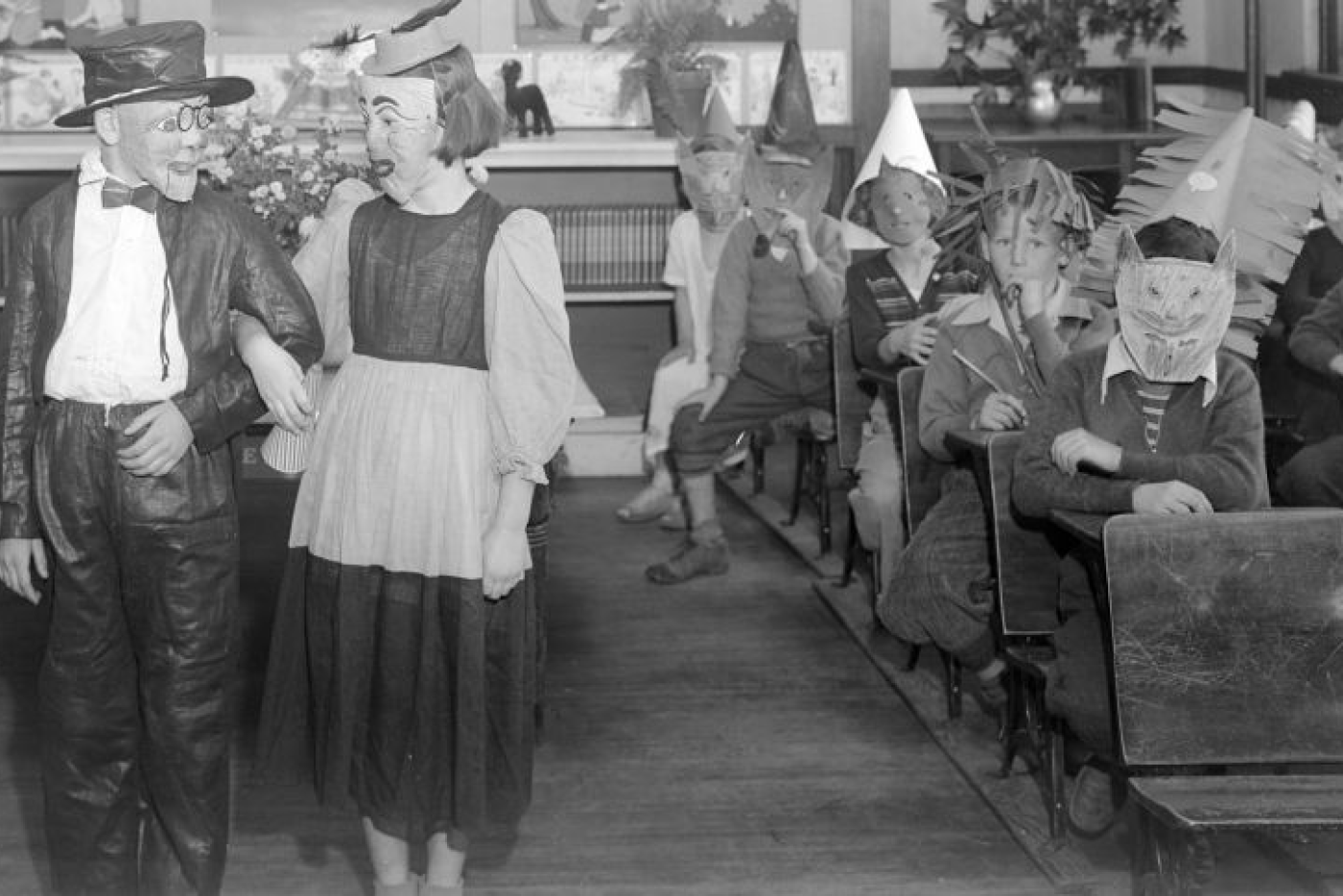
Header image: "Methodist Orphanage Halloween Party Oct 1945." Photo by Albert Barden. From the Albert Barden Collection, State Archives of North Carolina, Raleigh, NC.
Halloween is here, and the Come Hear NC Music Office has been haunted by a spine-tingling question: Does North Carolina have a distinctively spooky music culture? Perplexed, we sojourned down to the basement vault of the Department of Natural and Cultural Resources building to consult a witch’s cauldron salvaged in 1978 from the Devil’s Tramping Ground, in Bear Creek. Peering into its swirling and bubbling green brew, we queried it expectantly and watched as an unseen force lettered Y…E…S in a glowing liquid scrawl.
Forthwith, a spectral light enveloped the vault and us within it, and an unearthly voice disclosed an occult thesis:
While North Carolina’s Southern gothic literature may conform to regional and national stylistic cliches, the state’s modern music and movies do not. In fact, what defines the gothic mode in NC mass media is its revision, sometimes subtle and other times radical, of Southern gothic stereotypes.
Shocked by this imparted knowledge, we collected ourselves and reflected on what the disembodied phantasm from the beyond had imparted. Of course, the spirit was correct! Southern gothic literature, we realized, is often marked by a transposition of European gothic literature settings, themes, anxieties, characters, and plots to the context of the American South. The haunted castle becomes the haunted plantation, fears about colonies and Catholicism become anxieties about slavery and scalawags, while mad monks and malign aristocrats are transformed into degenerate preachers and ruthless planters. But when you look at North Carolina’s music and movies, that pattern does not hold. In spooky recorded music and music videos, the North Carolina difference obtains!
Shuddering in the wake of this new insight, we fled the witchy vault and headed upstairs, back to the safety of the NC Arts Council offices above. There, we quickly transcribed the following phantasmagoric communications of the witch’s cauldron, conveniently delivered to our stunned sensoria in the form of a historical review of some singularly eerie moments in North Carolina’s popular music:
“Murder of the Lawson Family,” the Carolina Buddies, 1930
“Murder of the Lawson Family” is the earliest example of the “modern” NC spooky song we’re discussing, and the most disturbing. The song deals with the slaying by Charlie Lawson of his wife and six of their seven children on Christmas Day in 1929 in their home in Germanton. It was recorded just three months later. The folk process that typically aestheticizes murder into myth over generations had not begun. Instead, this song is rough, clumsy, and filled with raw imaginings of the actual killing, replete with a heart-wrenching plea:
And the little ones did cry
"Please, Papa, won't you spare our lives?
For it is so hard to die!”
A workman-like guitar chug and ragged-but-right vocals from Walter Smith and the Buddies lay bare the ghastliness of what was for the band a contemporary, real-life atrocity. The singers hope God punishes Charlie Lawson, as his suicide meant he would never be tried for his crimes. “The Murder of the Lawson Family,” like the more famous song “The Ballad of Frankie Silver” (see below), paints a picture of a claustrophobic scene: a country home turned into a slaughterhouse offering no escape. One trick of NC gothic music comes from its inversion of the cozy hearthside, transforming an emblem of the very thing people treasure (familial closeness) into the source of harm and horror.
“Little Omie Wise,” Doc Watson (1964)
As the late writer Manly Wade Wellman, of Chapel Hill, tells it in Dead and Gone: Classic Crimes of North Carolina, Jonathan Lewis was a young Randolph County man looking to better his situation. A store clerk boarding with his boss in Asheboro during the week, he’d commute north by horse every weekend to Polecat Creek, in Guilford County, where his people lived.
It was on one of these equestrian circuits in the early 1800s that Lewis first set eyes on the orphan Naomi (Omie, Omi, or ’Omi) Wise. Passing the farm where Omie lived with her adopted family, Lewis asked Wise for a drink of water, the two courted, and soon Wise was expectantly collecting bits of furniture to decorate their future home as a married couple. But parents will meddle and Lewis’s mother supposedly wanted her son to move up in the world and marry his employer’s single daughter, one Hettie Elliott. Before poor ’Omie knew it, her intended beau stopped his visits to the farm (“without checking rein,” Wellman writes).
Then, after regretting a brief rekindling with Wise, Lewis returned to the farm with murder, not love, in mind. Wise’s body (with child) would be found, and a manhunt for a killer ensue. Lewis escaped to Kentucky, where he lived for the next six years. He was brought back to North Carolina for trial in 1815, only to be found innocent by a Randolph County jury.
Doc Watson’s take on the ballad demonstrates the North Carolina difference in its treatment of a horrifying tale: with delicate finger-picking and sparse vocal narration, Watson turns murder into a tale that is surprisingly stately and calm. It’s a sad tale, of course, but in Watson’s hands, it’s no longer a tear-jerker. Whereas a potboiling Southern gothic approach would lay the story on thick with sensation and melodrama, Watson creates a work of sepulchral inevitability. In North Carolina, the song seems to say, true terror comes not from overdone special effects or emotional jump scares but from the eerily placid sadness (streaked with beauty) that remains in the aftermath of loss. It’s an approach that continues to this day: North Carolina’s spooky music questions a horror rather than simply producing its effects. Maybe because we are caught between the Deep South and the ways of our supposedly more civilized and peaceable Northern neighbors, we both represent the traumas of Southern life and reflect on them—often, as with Watson’s rendition, in the same song.
“Sinnerman,” Nina Simone, 1965
No folksinger was ready for what Nina Simone did in 1965 with “Sinnerman”—a folk revival mash-up of several spirituals. She added galloping percussion to the song, which clocks in at more than 10 minutes. What most stands out is the absolute ferocity of Simone’s vocal and piano work, which play in rushing tandem to grip the listener by the neck and refuse to let go. In her hands, the song becomes an embodiment of the merciless, forceful pursuit of the sinner, and of the righteous power that follows the wrongdoer on Judgment Day. Because Simone recorded the song during the civil rights era, it’s easy to imagine that during this performance she was channeling her anger at moments of injustice that she and her family experienced in her hometown, Tryon. The absolute integration of every musical element, down to hand claps and backing vocals, takes this track from compelling to absolutely chilling in its single-mindedness.
“Cold Rain and Snow,” Dillard Chandler, 1975
With “Rain and Snow,” Dillard Chandler tells the story of a disgruntled wife-murderer from the perspective of the killer husband. A capella, Chandler intones the husband’s variations on a single marital complaint—he worked while she spent—before segueing without much warning to “I shot her through the head / and I laid her on the bed.” No moralism enters the tale in Chandler’s version, recorded by the folklore legend John Cohen. This song is not a cautionary tale. It’s offered as just what happens sometimes, and there are no lessons to be taught. A certain fatalism reigns in NC murder ballads. The same goes for Chandler’s presentation of the murdering husband’s “trembling to his knees” and “cold fear”: these aren’t meant to elicit sympathy for the murderer: he’s guilty as sin. Rather, Chandler seems to say that for him it’s sufficient to note the pain of the situation as if it were the changing of the leaves or some other natural occurrence.
“Little Margaret,” Sheila Kay Adams, 1982
This video records Sheila Kay Adams singing an early “Child ballad”—one of several hundred whose lyrics the American folklorist Francis James Child anthologized in the late nineteenth century—in the home of her great-aunt Dellie Chandler Norton. Both are North Carolina Heritage Awards honorees. As Norton and some children sit and listen in her living room, she mouths the words of the song as her great-niece sings them. A ghost story with a coldly consoling conclusion, “Little Margaret” tells of “sweet” William’s betrayal of Margaret to marry another. Margaret dies from grief and shows up as a specter at the foot of William’s marital bed. William wakes in horror to find Margaret dead and in her coffin and soon perishes from a broken heart. The two are buried side by side. Margaret’s grave flowers forth a rose and William’s a briar, and they intertwine in a “true love knot.”
Recorded in Burton Cove (an area of the Sodom Laurel community, in Madison County), this performance blends everyday life (a normal scene with kids and extended family) and a ballad familiar to the gathering. But there is an otherworldly look on Norton’s face as she listens to the lyrics, and the contrast is striking. If there is a North Carolina gothic, surely one of its defining touchstones is this mix of modes, in which familiarity with the pain of tragic circumstances and its partial redemption through song share space. The modern NC murder ballad, as handled here, avoids exploitative melodrama (as found in patronizing narratives of how the other half live) but also refuses to put a fine face on the realities of heartbreak and betrayal. What’s left is a compromise form, in which the listener feels the loss and the magic of art, as represented by the “true love knot” in which the “rose and the briar” are mysteriously intertwined.
“Uncut Story of Frankie Silver,” Bobby McMillon, 1992
NC Heritage Award honoree Bobby McMillon shows off his masterly storyteller chops in this clip, spinning a yarn on the real-life story behind “The Ballad of Frankie Silver.” A gallows song sung from the perspective of the murderess Frankie Silver, the ballad elicits sympathy for the female axe killer by focusing on her concern for her mortal soul and her horror at the crime she committed. It is a subjective view—one that hews to a firm belief in heaven and hell and Christian metaphysics but stays away from entering the narrative point-of-view of God, whether angry or merciful. In this video, the Toe River storyteller and musician Bobby McMillon goes deep into the backstory of Frankie Silver. “The truth probably won’t ever be known for sure,” he says. McMillon knows his details and has a demythologizing bent when it comes to such tropes as family curses, disembodied screams, and axe-wielding ghosts that strips none of the ballad’s curious fascination.
“Master of the Game,” Silica Gel, 1993
While the Triangle was in the throes of indie rock fever, Raleigh plunderphonics created this minor masterpiece out of a slowed-down yodel loop and a manipulated late-night news radio report. Equal parts goofy and spooky, “Master of the Game” slow-drips the tale of a Southern pedestrian killed by a car on a Georgia highway. As details of the story lugubriously unfold, it’s revealed that the victim was something of a Lost Cause loser. The payoff of the song comes with the time-stretched and distorted newscaster’s voice announcing that the unidentified casualty had several tattoos, including “a skeleton in a confederate uniform” and “on his left back shoulder the words ‘Master of the Game.’” The irony of such distasteful braggadocio tied to a roadside fatality spawns a black comedic feeling in the listener. The mix of everyday human pity and absurdist satire in the song, underlined by its haunting but toy instrument-like sonics, is a good example of postmodern NC gothic. The song doesn’t ask you to choose between mystery and mockery; it makes you feel them both at once.
“Pure,” Secret Shame, 2021
The Asheville deathrock/post-punk group Secret Shame, like Silica Gel, cut its dark imaginings with an off-kilter sense of humor. The band dons theatrical makeup and dress, with lead singer Lena Machina often wearing clown face. Self-aware, the band members in the video for “Pure” play on the stereotype of goth music as overwrought and humorless, posing with stuffed animals and dancing in a bamboo forest (the one at Duke Gardens?) while their chilly music plays. Perhaps what defines recent spooky NC music is a commitment both to recognizing the awful and horrible and finding some means to laugh through music-making.
“Die (And Rot),” Babe Haven, 2024
Durham-by-way-of-Boone punk/metal band Babe Haven brings a fun fury to the “Die (And Rot)” video. The visual element has the aesthetic of a haunted house, communicating therighteous glee of punishing one’s tormenter.
As we finished transcribing the words above, the ghastly voice from the vault commanded us to stop with a booming “Enough!” We complied and took our hands away from the keyboard. But soon we called out: What of Arthur “Guitar” Smith’s haunting Moog soundtrack to Earl Owensby’s movie Dark Sunday? The retro phantasmic 1950s music in David Lynch’s Blue Velvet? Charlie Daniels’s kitsch Southern gothic track “The Legend of Wooley Swamp”? And what of whole albums of heaviness from Corrosion of Conformity?

“Let the readers find out for themselves,” the ghost of the Department of the Natural Resources commanded. “The well of North Carolina horror runs deep and dark, and if you peer into its waters too long, who knows what fate might befall you.” So, we heeded the specter’s warning, and went to get a cup of coffee from the Keurig in the kitchenette.