
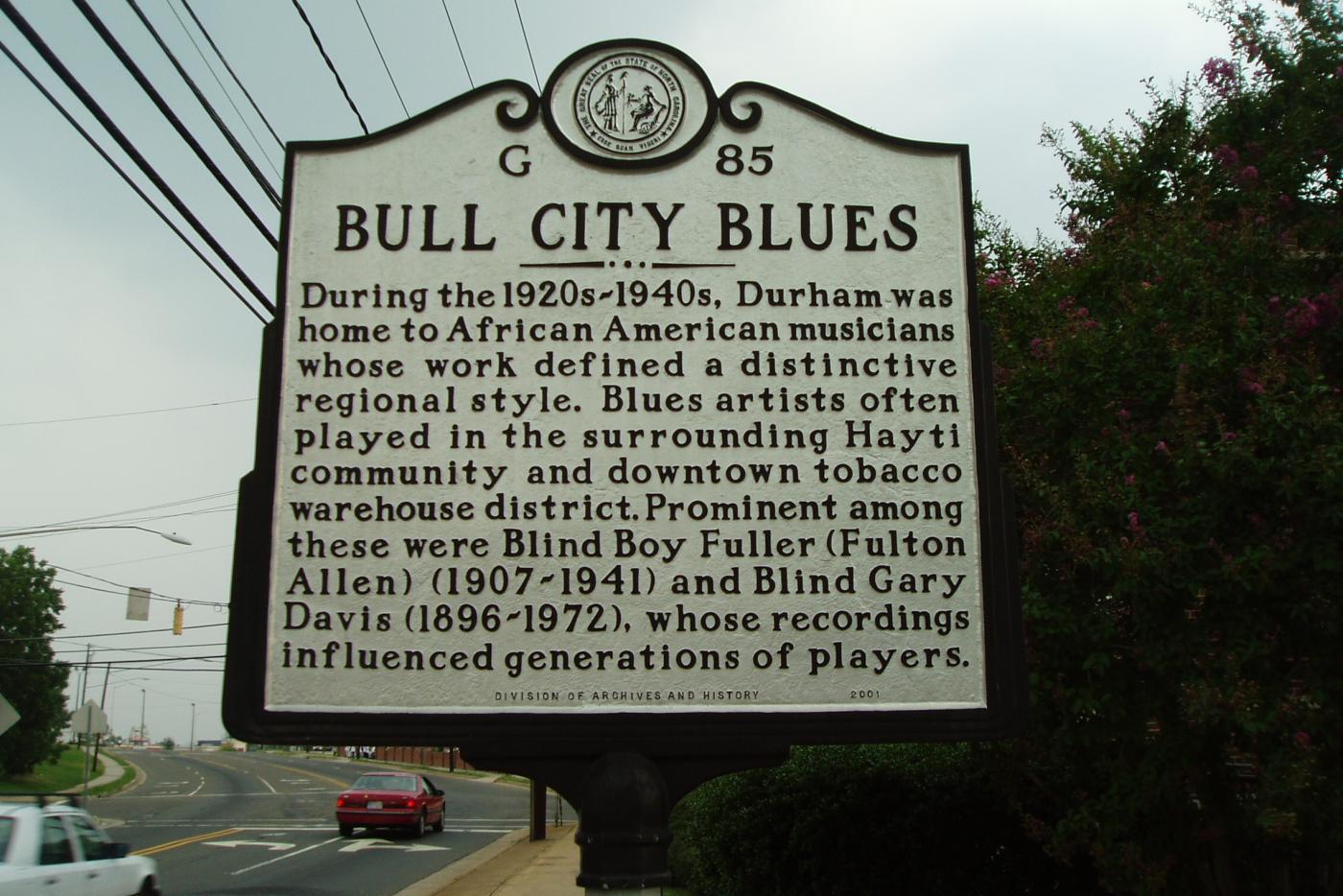
Header image: "Bull City Blues" historical marker in Durham, NC. Photo courtesy of the NC Department of Natural and Cultural Resources.
July is Disability Pride Month, which honors the passage of the Americans with Disabilities Act (ADA) on July 26, 1990. This landmark act established federal civil rights protections for the disabled and enshrined into law both basic accessibility requirements for public spaces and reasonable accommodations in workplaces.
To mark the observance this year, we’ll explore the meaning of disability for three North Carolinian blues and folk guitar legends: Reverend Gary Davis (Durham); Fulton Allen, who performed as Blind Boy Fuller (Wadesboro/Rockingham/Durham); and Arthel Lane Watson, who performed as Doc Watson (Deep Gap). All three North Carolinians were blind, and all three made music that established whole new modes and genres: Davis and Fuller basically invented Piedmont blues, and Doc Watson perfected modern flat-picking.
Starting in the 1920s, Davis and his sometime-acolyte Fuller combined syncopated bass thumbing with melodic fingerpicking to generate a jauntier, more ragtime-influenced style of blues than was heard in the Mississippi Delta. For example, Fuller’s “Step It Up and Go” and Davis’s “Samson and Delilah” (also known as “If I Had My Way”) both feature sprightly rhythms and flowing melodic runs beyond the ken of the average 12-bar blues. In 1920s Durham, Fuller and Davis learned some of those tricks from recordings by another disabled musician, Georgia’s Blind Blake.
Later, at the outset of the 1960s, Doc Watson brought acoustic guitar flat-picking to a new level, translating a host of Appalachian-by-way-of-the-British-Isles fiddle and banjo tunes for use on his Martins and Gallaghers. Using just his thumb and index finger, Watson modeled a technique to sound out single notes with speed and clarity, in emulation of what the musician and writer Thomas Goldsmith has described as the “flowing, rapid attack” of the old-time fiddlers. As Watson’s technique caught on, it would inspire most every guitar player working in folk and bluegrass from the early 1960s on to the present day, much as Davis and Fuller influenced everybody from Dave Van Ronk and Bob Dylan to the Grateful Dead and Eric Clapton.
The figure of the blind musician, and particularly the blind blues guitar prodigy, has become shrouded in myth. It had already become a cliché in 1959 when the future fingerstyle legend John Fahey released his first LP under the satirical persona “Blind Joe Death.” In the popular perception, blindness and music, especially when attached to blackness, has signified magic in music, a disabled musician’s so-called superpower. This sort of fanciful thinking is deeply rooted in ableism and racism: it erases the labor, craft, and struggle these artists put into their art, as if musical creativity effortlessly flowed from them only because they were disabled.
This so-called “supercrip” mythology neglects the material conditions in which Davis and Fuller, even more than Watson, produced their music. In the 1920s, playing the blues would have been one of the few means of employment available to a blind man in North Carolina. With a scant social safety net to fall back on, Davis and Fuller both calculated that busking for relatively flush just-paid tobacco workers in Durham made subsistence-level economic as well as aesthetic sense.
Of course, being blind certainly had an effect on the musical practice of these artists. Sound can be easier to focus on in the absence of visual stimuli: this is why, for example, sighted people sometimes close their eyes to listen more intently to a piece of music. And the different set of employment conditions for the disabled can allow time and space to focus on an artistic craft. Still, it’s not magic (though the music the three made often sounds magical)—just human adaptation to circumstance. What’s more, being blind created practical musical roadblocks as well as opportunities:
Being blind, neither [Davis nor Fuller] was able to tell when the red light came on in the studio to inform artists that it was time to end, so that a complete master could be cut. Either Long [James Baxter Long, producer] or Red [Bull City Red, fellow musician] had to touch the singer on the arm to notify when to finish.
(quoted in Stefan Grossman’s Blind Boy Fuller: Early Masters of the Guitar)
In other words, real economic, practical, and cultural hardship coexisted with the creation of pathbreaking musical forms. Davis’s mother refused to raise him, giving him away to his grandmother because he could not see. Fuller faced grinding poverty and died in his thirties owing to a lifetime’s worth of medical struggles. Being blind did not bring Davis, Fuller, or Watson natural musicality. Nor were they child-like innocents or saintly miracle workers: they were imperfect people, like the rest of us. Davis could be arrogant and jealous; Fuller could be angry and impulsive. (Notoriously, he shot his wife in the leg and spent time in the Durham County jail for it.)
Deep Gap’s Doc Watson, decades later and in the whiter western part of the state, had his own complex experience of being a disabled musician. “A handicapped person cannot pay dues without a lot of help,” he told Eddie Huffman, as recorded in Huffman’s book Doc Watson: A Life in Music. (All subsequent quotes here are from Huffman’s biography unless otherwise identified.) Yet he labored long and hard, and crafted a new musical style. For Watson, too, being blind meant both hardship and human possibility—subjection and autonomy. While generally affable and wise, Watson could also be emotionally withdrawn and struggled with workaholism—responses at least in part to mistreatment he suffered growing up.
For example, Watson’s experience at the State School for the Blind and Deaf, in Raleigh, was harrowingly prejudiced, filled with “harsh physical discipline and emotional abuse,” because, as he recalled, “they didn’t understand blind people then, and they made you feel like a misfit.” That repressive institutional setting, though, was where Watson learned music, taught by a blind teacher, Nora Norris, whom he called “a godsend to that school” and “a D-double-A number one teacher.” At the State School, Watson also bonded over music with a fellow visually impaired student, Paul Montgomery, who like him went on to have a career as a musician.
Music itself sometimes provided opportunities for discrimination against Watson and his classmates, albeit of a more subtle kind. Montgomery recalls being put on display like “a little trained chimp” to “perform for state government officials and other high-profile visitors.” And in a twinned act of ableism and classism, a matron at the school named Tanner once slapped young Watson for the offense of picking out a country tune on his banjo. Watson later remarked about this and other incidents: “I knowed old Tanner’d kill me there at Raleigh if I cried too much.” It’s sobering to think that this was more than 30 years after Davis’s and Fuller’s struggles in Durham; one can only imagine the sort of discrimination, casual and explicit, that the blind and black Davis and Fuller must have experienced decades earlier.
Watson, of course, went on to become a cherished musical hero, both in and out of North Carolina. Over countless records and decades of performances, many with his son Merle and others in the Watson family, he made bluegrass and folk music that won hearts and influenced whole generations of pickers. MerleFest, the festival he started after Merle died, is now one of the largest traditional (“plus”) music events in the country. Watson won seven Grammys, including a Lifetime Achievement Award. In 1997, President Bill Clinton awarded him the National Medal of Arts, and he’s in the International Bluegrass Music Association Hall of Honor. The Department of Natural and Cultural Resources gave Watson the North Carolina Award in 1986, and the North Carolina Arts Council gave him a North Carolina Heritage Award in 1994. Like the contributions of Davis and Fuller to North Carolina’s place in music history, Watson’s are secure.
The struggles of these musicians are not unique. Family members and friends mocked and scammed Beethoven as he became deaf; people patronized and exploited the blind Ray Charles; faith healers dug their fingers in “Little” Stevie Wonder’s eyes; the mother of the North Carolinian country star Ronnie Milsap gave him away at birth for being blind, just as Gary Davis’s mother did. Writers often comment that disabled artists “overcame” their disabilities to create well-loved music. They did not. Other people hurt these disabled artists more than their disabilities ever could.
While disabilities present obvious challenges, they are also a part of the daily lives of many people and help to define who they are. It makes about as much sense to say you “overcame” your heartbeat or your need to breathe as it does say you overcame your blindness. In the life stories of Reverend Gary Davis, Blind Boy Fuller, and Doc Watson, the fact that the world’s society and infrastructure were not built with disabled people in mind presented more severe challenges to their music making than anything else. As a result, this Disability Pride Month, we should reflect on how sighted people in North Carolina held these musicians back and hurt them, what others here did to nurture them, and how we make sure to continue the help for disabled people while mitigating the harm.