
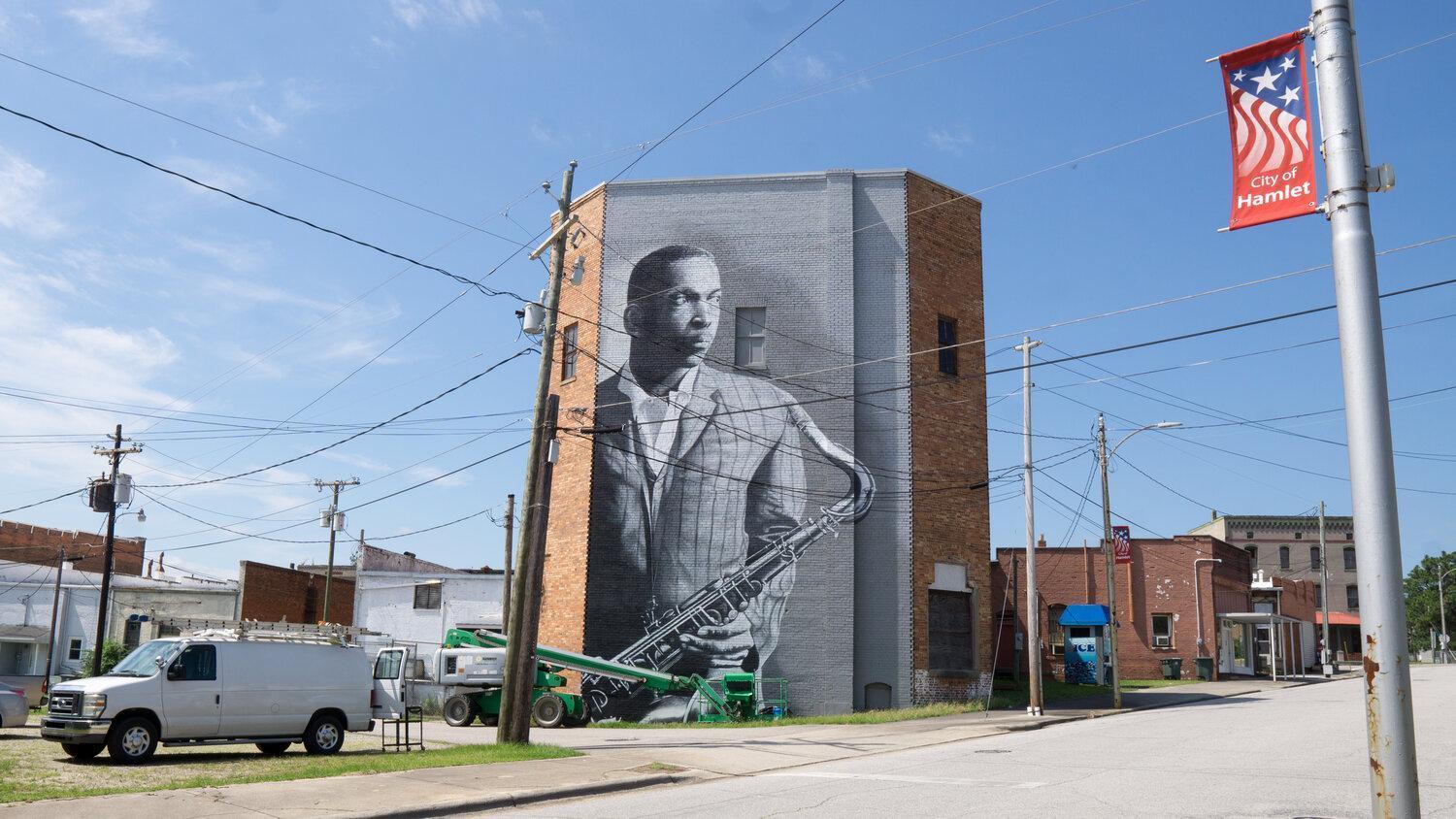
John William Coltrane, legendary jazz saxophonist, was born in Hamlet, NC on September 23, 1926. The son of Alice Blair and John W. Coltrane, Sr., by the time of his death in 1967, Coltrane had achieved international preeminence as a giant of jazz. In 1955, Coltrane joined the Miles Davis Quintet, which was to become one of the outstanding jazz group of its era. With Davis, Coltrane first attracted attention for his distinctive style on sax. Coltrane's music, although influenced by many forms, was unique in its development and exploration of sixteenth notes as a rhythmic base. His superb technical skill on the saxophone enabled him to experiment freely a variety of modes during improvisation.
“I know that there are bad forces, forces that bring suffering to others and misery to the world. I want to be the opposite force. I want to be the force which is truly for good.”
Biography
In The Making of Jazz: A Comprehensive History, James Lincoln Collier wrote that “the history of jazz is filled with names of musicians who have been extravagantly admired [...] but no jazz musician has ever received the extreme adulation visited on John Coltrane.” In NC, two towns make claims on Coltrane -- Hamlet where he was born, and High Point where he was raised until age seventeen.
Coltrane's musical training began in high school, where he studied on the E-flat alto horn, clarinet, and saxophone. He continued his training at Granoff Studios and Ornstein School of Music in Philadelphia, making his professional debut in 1945 as a member of a cocktail party combo. He served in Hawaii with the U.S. Navy Band in 1945–46, and, upon returning to civilian life, toured as a sideman with Eddie Vinson's rhythm and blues band in 1947–48. He played in Dizzy Gillespie's big band from 1949–1951, Earl Bostic in 1952–53, and Johnny Hodges in 1953–54.
John Coltrane was born on Bridges Street in Hamlet. The building has recently been restored, and now houses the local chapter of the National Association for the Advancement of Colored People. It bears a small cornerstone noting Coltrane's birth. At three months, Coltrane and his family moved to High Point where they lived on Underhill Street. That house, too, remains. Coltrane lived there until he completed high school at William Penn High School in Philadelphia, where he played clarinet and saxophone.
After high school, Coltrane moved to Philadelphia where he attended music school. He made his professional debut in 1945 and collaborated with Dizzy Gillespie, Thelonious Monk, and Miles Davis on milestone recordings, before forming his own group in 1960. In the years before his death at forty, he “achieved the rare feat of establishing avant-garde jazz, temporarily, as popular music,” according to critic Martin Williams.
The Coltrane band was one of the most original and influential groups in jazz from 1961 to 1965. Coltrane reached the peak of critical and public acclaim in 1965, winning from Down Beat awards for being America's best tenor saxophonist, Jazzman of the Year, and winning Record of the Year for the composition and recording of A Love Supreme.
From 1965 to 1967, he experimented broadly with the instrumentation of his ensemble, and developed a predilection for modality and multi-horn improvisation. Coltrane's music increasingly absorbed influences from Indian, Southeast Asian, and African forms. At his death, he stood as an unquestioned jazz master, with some even going so far as to dub Coltrane a "jazz messiah."
Miles Davis with John Coltrane
Coltrane recorded for a number of record companies, including Columbia, Riverside, Blue Note, Prestige, Atlantic, and Impulse. Among his important recordings are Blue Train, Giant Steps, My Favorite Things, Impressions, A Love Supreme, Ascension, and Naima.
He was married to Alice Coltrane (née McLeod), a uniquely talented pianist and harpist. He died in Huntington, N.Y., with memorial services at St. Peter's Lutheran Church in New York City.