
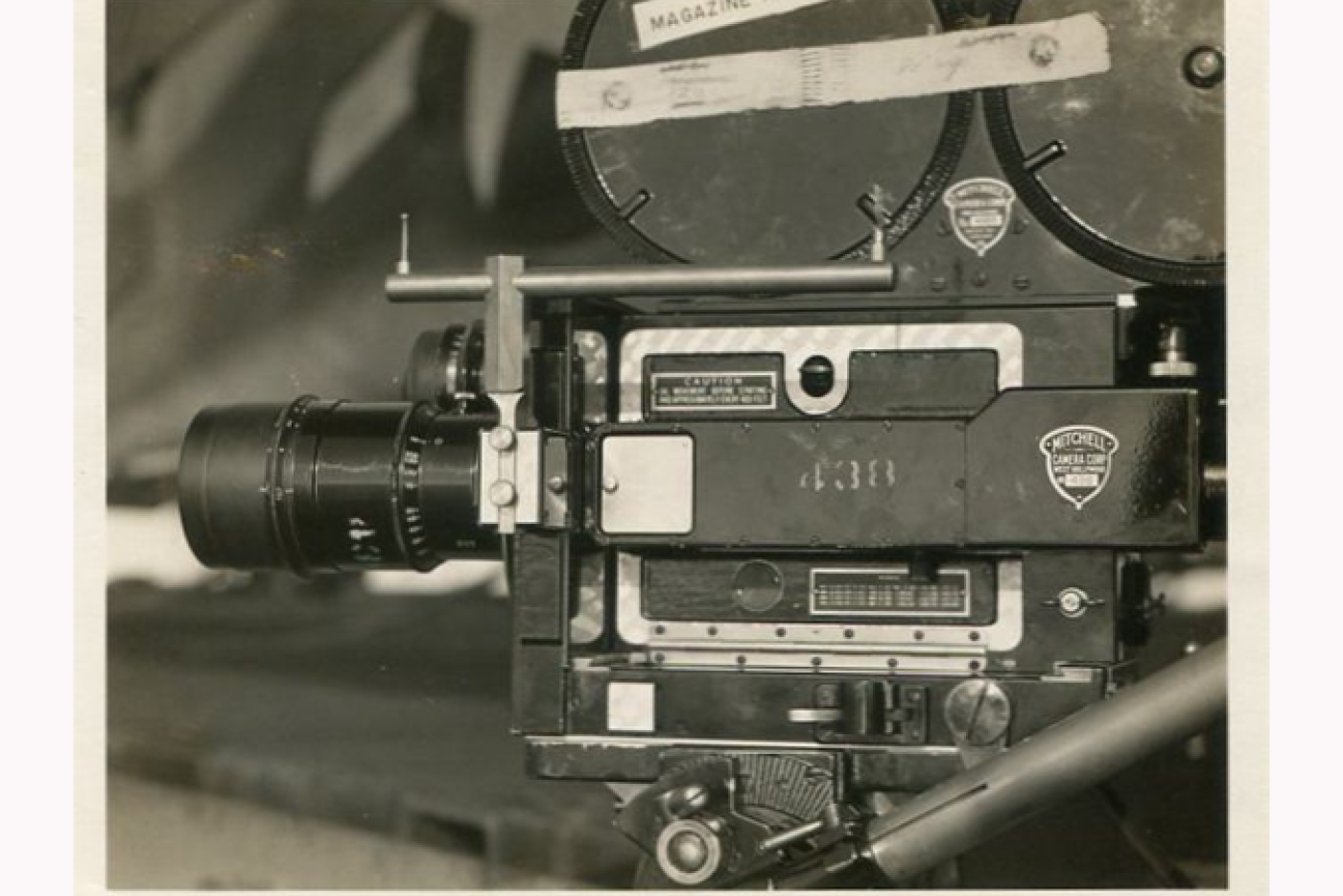
Header image: Closeup photograph of the side of a Mitchell 35mm motion picture camera, From Guy O. Cox Papers, WWII 165, World War II Papers, Military Collection, State Archives of North Carolina, Raleigh, N.C.
“Film festivals tend to be infrastructure for film making and digital media,” according to Dan Brawley, who heads the Cucalorus Film Festival, in Wilmington, as its “Chief Instigating Officer.” Because digital tools and social media have combined to make both moviemaking and moviegoing less communal, there’s a resurging need for in-person gatherings such as Cucalorus. Now in its thirty-second year, Cucalorus has fostered the community building, skill sharing, taste-making, and collaboration necessary for a healthy film scene in this state.
Brawley speaks about NC film from long experience. Raised in Wilmington, he grew up in the era when the legendary producer Dino De Laurentiis (Fellini, Godard, Pollack, Friedkin, Milius) brought Hollywood productions to “Wilmywood,” starting with 1984’s adaptation of the Stephen King novel Firestarter (starring Drew Barrymore and Martin Sheen and directed by Mark L. Lester) and followed the next year by Blue Velvet, directed by David Lynch. He left to go to Duke, and after graduation, he returned to Wilmington and began volunteering at Cucalorus, the “biggest, weirdest, funkiest gathering of cinephiles to hit the Port City” (Amy Conry Davis). Now he runs the festival and labors to connect and develop cinematic workers in our state and beyond. In short, Brawley’s a vet.
Under his guidance, Cucalorus has expanded into a full-blown support network for burgeoning film talent and fans alike. Brawley points to the tradition of scrappy grassroots filmmaking in North Carolina as both a historically defining feature and a standard to uphold into the future. This local, human element unites filmmaking in North Carolina across the analog/digital divide. When asked about the beginnings of the modern NC film industry, Brawley starts with Earl Owensby, of Shelby. What interests him as much as Owensby’s Southern B-movie filmmaking—Dark Sunday (1976); Rottweiler: Dogs of Hell, which Owensby described as “Jaws with paws” (1982); and Chain Gang (1984), to name three—is Owensby’s role as a connector for the entire state’s movie scene past and present.
Brawley and many others in the know see Owensby as central to the development of the film industry here as it exists today. It’s not just that Owensby’s “grindhouse” moviemaking put North Carolina on the map (at first internationally, and then, much later, with influential domestic connoisseurs of exploitation flicks such as the director Quentin Tarantino). When De Laurentiis began scouting around the state, he started in Shelby at Owensby’s EO Corporation studios. Owensby had proven that movies could be made in the state, and so the EO Corporation became the model for the De Laurentiis Entertainment Group (now Screen Gems) in Wilmington. Without Owensby, the Lester and Lynch projects so associated with launching North Carolina as “Hollywood East” might never have happened. Owensby’s outlandish vision paved the way for bigger-budget, better-thought-through films that followed.
A case in point is the story of the abandoned nuclear reactor that Owensby bought across the NC state line, in Gaffney, SC. Owensby’s dreams of converting the reactor to a film studio never quite panned out, but the director James Cameron (The Terminator, Aliens, Titanic, Avatar) later rented the facility, filled the silos with water, and used them to shoot deep-sea footage in The Abyss (1989). As further proof of the down-home lineage of the NC movie scene, Brawley notes that in 2000, when David Gordon Green, a North Carolina School of the Arts graduate, began his career as a director, he drove to Shelby to borrow a camera from Owensby. Green went on to make the movies George Washington, Pineapple Express, and the new Halloween movie trilogy. As Brawley sums up the Owensby/De Laurentiis era, “That first phase really had a nice ripple effect. Today there are production companies everywhere.”
According to Brawley, now is yet another transformative moment for film festivals and the film industry generally in North Carolina. New niche festivals across the state crop up every year; Cucalorus, for example, has Surfalorus, a surf movie-only film festival. At the same time, indie filmmaking has exploded with the rise of good and affordable digital filmmaking equipment.
To explain the context, Brawley describes a paired shift toward the mainstreaming of moviemaking into everyday life (most major corporations have filmmakers on staff, he notes) with the increasing need for third spaces for film folk to talk shop, swap ideas, and develop professional and personal partnerships: “Everybody's making a movie every day. And I know this year, Cucalorus is probably going to have five or six North Carolina features. I can't remember a time when we had that many made in North Carolina at the festival.”
The Cucalorus Film Foundation, the festival’s umbrella organization, has become just such an infrastructural support hub for movie folk in North Carolina. The festival is the most public-facing part of Cucalorus’s work. The foundation’s website details the end-to-end assistance that the foundation provides: “building financial and creative careers through project funding, workforce development programs, project development support, exhibition, education, and residencies.” As this list shows, then, Cucalorus helps burgeoning filmmakers economically, pedagogically, aesthetically, and socially.
The foundation’s Filmed in NC Fund supports the production of indie film and video projects by NC residents and full-time students at a college or university in the state. A collaboration with the NC Film Office, the fund aims to support projects with budgets under $1,500,000. The Works-In-Progress Lab supports social justice documentaries with a focus on Black storytelling. The Immersion Lab combines training in the use of new virtual reality tools to create work that considers Wilmington’s racial history and how that shapes the present. The Regional Engagement and Education Program supports the screening of films across the state to promote media literacy. Jengo’s Playhouse, in an area of Wilmington known as the Soda Pop District, is the festival’s permanent cinema and community space.
When Brawley looks back on filmmaking in our state, he remarks that it has always featured “bold, weird movies.” Even the big productions made here tend to be a little off-kilter: Blue Velvet, for example, is a classic movie, but certainly of a different sort from the standard Hollywood blockbuster. With the Cucalorus Film Foundation, Brawley and company seek to protect and extend the bold and weird legacy of the North Carolina film tradition. While committed to breaking new ground in visual storytelling, they also keep faith with the knowledge that moviemaking requires down-to-earth, grassroots material support: the economic, social, and political infrastructure that allows it to flower and grow.
The thirty-second annual Cucalorus Film Festival runs November 18–22, 2026, in downtown Wilmington, NC.