
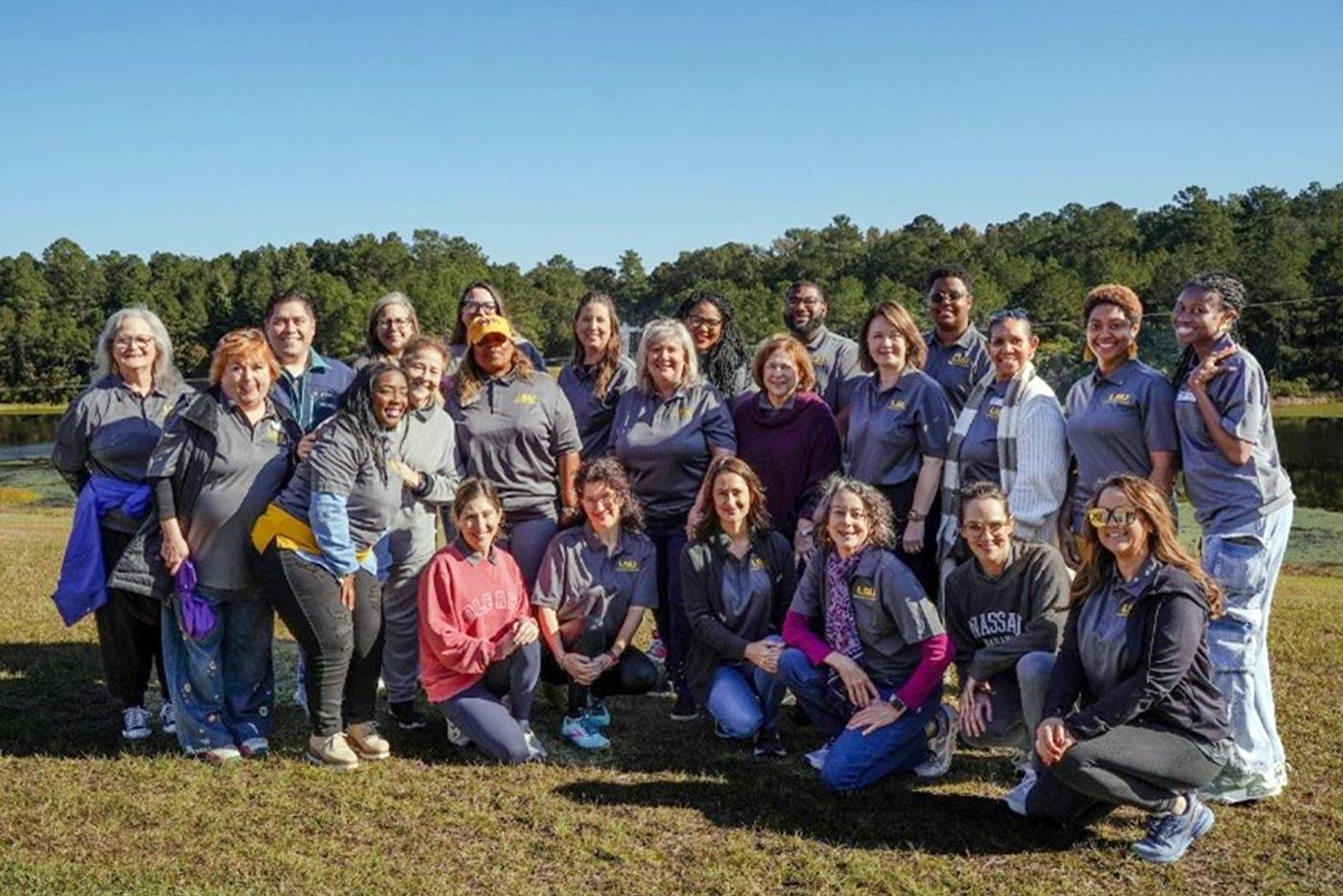
Header image: 2025 Louisiana A+ Schools Fall Fellows’ Retreat, photo courtesy of Louisiana A+ Schools
Launched in North Carolina in 1995 by the Kenan Institute for the Arts, and later integrated in the North Carolina Arts Council, the A+ model grew across state lines, inspiring networks to sprout in Oklahoma, Arkansas, and Louisiana. (Its success eventually led schools in Switzerland and South Africa to adopt the framework, thus expanding the network globally.) To strengthen their shared commitment to A+ essentials, the U.S. schools formed the National A+ Schools Consortium. The consortium drives growth and refinement of the model through professional development, networking, and research, while honoring each state’s unique approach. Consortium members also lead conversations on the role of arts in whole-school reform and influence educational policy across member states.
Behind each of these innovative state networks lies a story. Here’s how three states brought the A+ vision to life.
In 1999, the DaVinci Institute—a higher-education think tank—convened researchers from the University of Oklahoma and Oklahoma State University to survey arts-integrated education reform nationwide. Their research pointed to North Carolina’s A+ Schools as the strongest model, meeting the criteria for success defined by DaVinci Institute members. Inspired by this finding, Oklahoma launched its own A+ Schools initiative (OKA+) guided by mentorship from North Carolina.
By 2002, OKA+ was fully operational, with the University of Central Oklahoma hosting the organization on its campus. That summer, 14 inaugural schools joined the network and began a three-year implementation process. Within five years, 39 schools had joined, and research confirmed that the arts-integrated model improved attendance, test scores, discipline, engagement, teacher practice, and more across grade levels.
As the network expanded, the University of Central Oklahoma embraced the A+ model and its long-term potential. In 2019, UCO established the Oklahoma A+ Schools Institute, opening doors to greater growth, funding, and impact for the network and its projects. Despite pandemic challenges, OKA+ continued to thrive, building collaborations, mentorships, and partnerships with schools and organizations across state and international lines.
Since 2002, OKA+ has trained more than 100 schools and continues to envision learning environments where arts integration benefits everyone. Its mission is to expand the network and spark innovation, imagination, and creativity in students, teachers, and classrooms all over the state.
Next, inspired by A+ Schools of North Carolina, Arkansas launched its A+ network in 2003. The Arkansas schools successfully established the program for several years but paused in 2007 during a leadership transition. The Thea Foundation reignited the initiative in 2011, committing to 11 schools and restoring A+ professional development across public, private, and charter schools statewide.
The University of Arkansas College of Education and Health Professionals took the network under its leadership, using the opportunity for research and educational development. Today, the network consists of 16 member schools and continues to expand opportunities for educators throughout Arkansas.
Finally, Louisiana joined the movement in 2013, with mentorship from OKA+. The George Rodrigue Foundation of the Arts initiated the network and after several years of success, fledged Louisiana A+ Schools (LAA+) to stand on its own as a public nonprofit organization. This step ensured growth and long-term sustainability. In 2023, LAA+ expanded its reach by joining Louisiana State University. Becoming a program of the LSU School of Education provided significant opportunities and access to additional resources.
“Becoming an A+ school may be the very best decision you and your staff could ever make. The training and support provided by the LAA+ Network is unparalleled. The energy and focus it brings to your school is transformational. Our students are performing better on academic standards because they are able to connect with the content in so many different ways than in a traditional school setting.” — LAA+ Principal